Every workers' comp operation has a room — or a desk, or a corner — where paper arrives. Itemized bills, medical records, correspondence, authorizations. Someone scans it, names it, sorts it, and moves it somewhere the rest of the business can find it. None of that work shows up in a bill review metric, and all of it sits directly in front of every downstream deadline.
The failure modes are familiar. A 60-page stack gets scanned as one document because splitting it by hand is tedious. A page goes in upside down and nobody notices until an adjuster opens it three days later. A batch stops uploading halfway and the incomplete file looks finished. Every one of those is cheap to fix at the scanner and expensive to fix anywhere else.
RB Scan fixes them at the scanner.
Scan the stack once
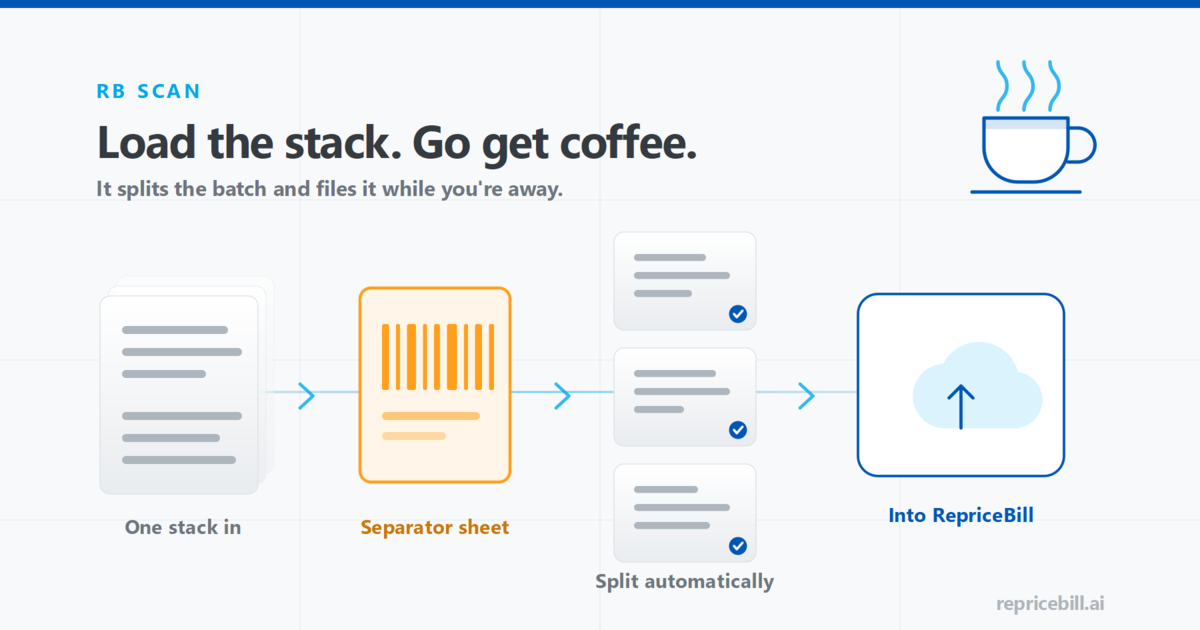
Print separator sheets, drop one between each document, and load the whole stack into the feeder in a single pass. RB Scan finds the separators and splits the batch into individual documents on its own — and it recognises a separator whichever way up it was fed, because nobody in a real mailroom checks sheet orientation.
Batch splitting ships switched off. Turning it on is a decision someone makes deliberately, on a screen, rather than a default that quietly changes what a clinic sends you.
Pages that read themselves
RB Scan recognises pages as they come through, and does that work right there on the desk rather than shipping your documents somewhere to be analysed. It is layered, which is what matters in a real mailroom: if a page carries a barcode, that is used; if not, RB Scan recognises the sheet by sight; if a document already arrived in a readable form, it is read directly. You get the benefit on good days and a working system on bad ones.
Pages can also be stamped as they are assembled — a received date, a reference number — with the operator controlling where the stamp lands and what it is allowed to cover.
Fix problems at the desk, not three days later
Before anything leaves, the operator sees the whole batch and can put it right: drag pages into the correct order, rotate the one that came in sideways, drop the blank reverse of a double-sided sheet. A file that is still being copied is held back until it is whole, so nothing half-finished gets sent on.
- Works with the scanners you already own — desktop, networked, or Wi-Fi
- Same sign-in as the rest of RepriceBill — no second user list to maintain
- Operators never handle passwords for your document store
- Work does not stop when the network does — delivery resumes on its own
- A document only counts as delivered when it is complete
What RB Scan deliberately does not do
RB Scan does not classify a document, and it does not decide which bill, patient, or claim it belongs to. Its whole job is moving documents from the desk into your workflow, reliably and verifiably. Everything after that — matching, repricing, review — is handled by the rest of the RepriceBill platform, which is where that belongs. A transport layer that quietly reinterprets documents is one you cannot audit.
Who benefits
Mailroom and intake teams who handle the daily stack, operations managers who own turnaround time, and TPAs running several intake points who need every location to behave the same way.
The value
Less handling per document, fewer re-requests for pages that were never scanned properly, and a shorter gap between paper arriving and a reviewer being able to work on it. The cost of a bad page climbs every hour it stays in your system — ten seconds at the scanner beats a re-request three days later.
Book a Free Workflow Audit